


The Department of Religious Studies examines religious beliefs, institutions and practices using approaches from the humanities, arts, social sciences and sciences. The academic study of religion, combined with appropriate courses in other fields, provides an excellent background for any professional career—including law, engineering, medicine and health care professions, journalism, social work and others—and for graduate studies in a number of fields.
A major in religious studies provides a well-rounded liberal arts education or can be combined conveniently with a second major. Minors or sequences in religious studies complement and broaden any field chosen as a major.
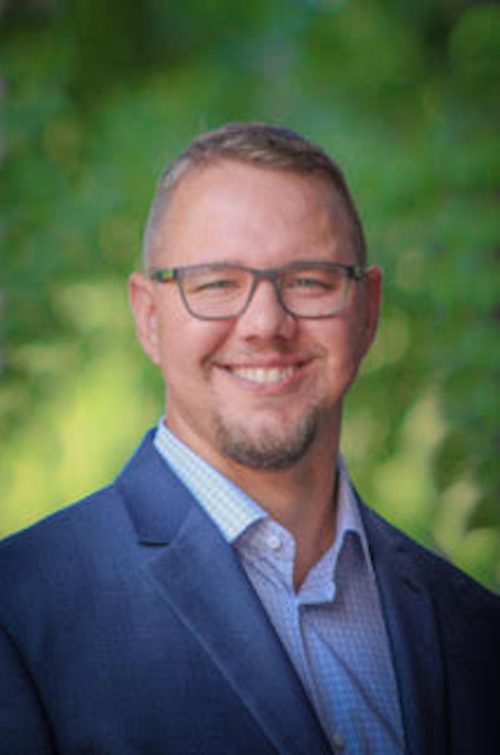
Dr. Brian Clites’ recent article, “Unreconciled,” trending in the New York Times
On August 5th, 2026, Dr. Brian Clites’ article, “Unreconciled: The Shared Suffering of Clergy Sexual Abuse,” was published in NYU’s public-facing religion magazine, The Revealer. The article has gained traction and was featured on September 13th, 2026 in the “trending now” section of the New York Time’s “Believing,” a weekly Newsletter authored by their religion editor.
This piece centers on a play of the same name, “Unreconciled,” exploring what a community knew about a priest who abused their children for years. Brian J. Clites is the Archbishop Paul J. Hallinan Professor II of Catholic Studies and assistant professor of Religious Studies. His current book project, Surviving Soul Murder (forthcoming, NYU Press), argues that survivors’ lived experiences are essential to understanding American Catholic culture.
Congratulations Dr. Clites!
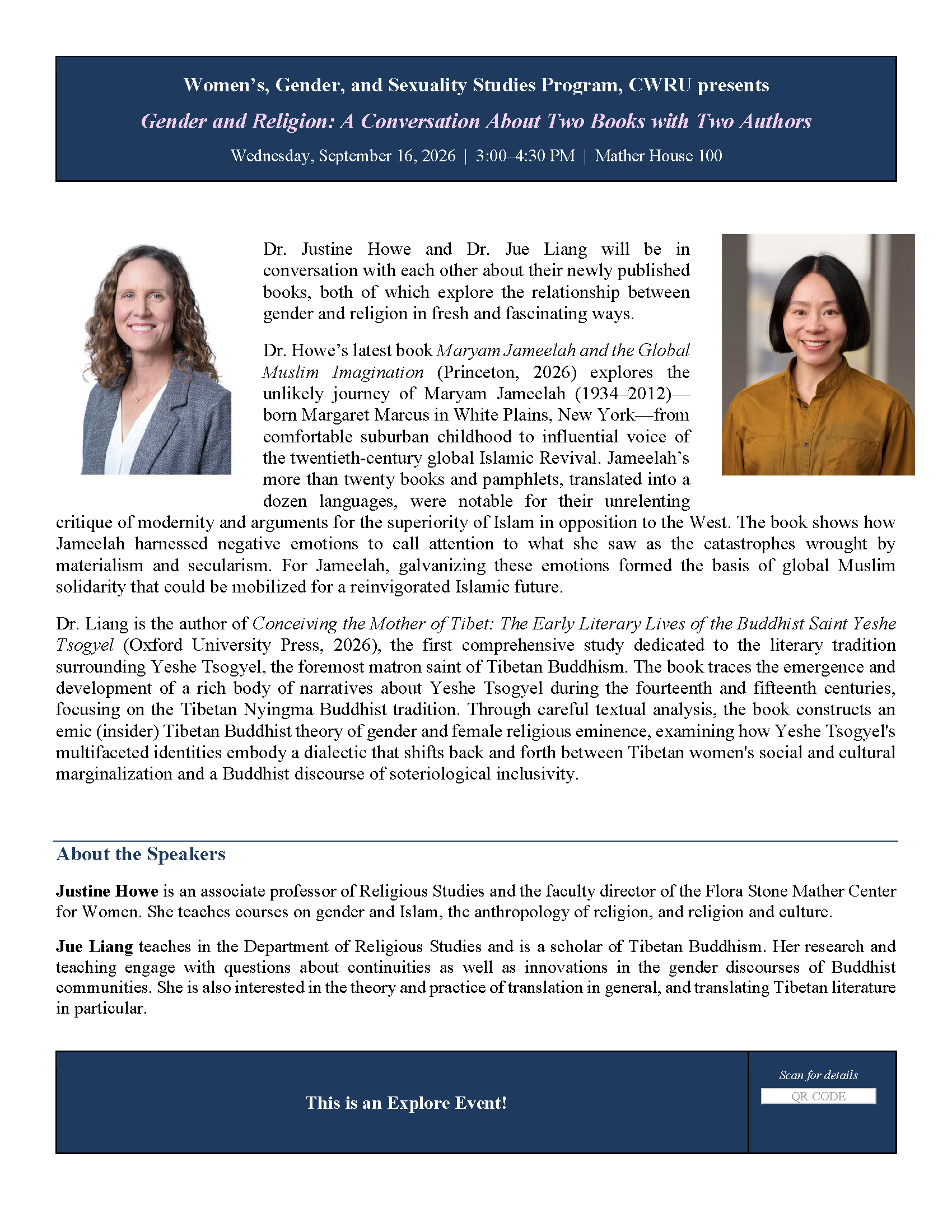
A conversation with Dr. Justine Howe and Dr. Jue Liang on their latest books – Sep. 16 2026
Women’s, Gender, and Sexuality Studies Program presents “Gender and Religion: A Conversation About Two Books with Two Authors.”
Wednesday, September 16th, 2026 | 3:00-4:30 pm | Mather House 100
Dr. Justine Howe and Dr. Jue Liang will be in conversation with each other about their newly published books, both of which explore the relationship between gender and religion in fresh and fascinating ways.
Dr. Howe’s latest book Maryam Jameelah and the Global Muslim Imagination (Princeton, 2026) explores the unlikely journey of Maryam Jameelah (1934–2012)—born Margaret Marcus in White Plains, New York—from comfortable suburban childhood to influential voice of the twentieth-century global Islamic Revival. Jameelah’s more than twenty books and pamphlets, translated into a dozen languages, were notable for their unrelenting critique of modernity and arguments for the superiority of Islam in opposition to the West. The book shows how Jameelah harnessed negative emotions to call attention to what she saw as the catastrophes wrought by materialism and secularism. For Jameelah, galvanizing these emotions formed the basis of global Muslim solidarity that could be mobilized for a reinvigorated Islamic future.
Dr. Liang is the author of Conceiving the Mother of Tibet: The Early Literary Lives of the Buddhist Saint Yeshe Tsogyel (Oxford University Press, 2026), the first comprehensive study dedicated to the literary tradition surrounding Yeshe Tsogyel, the foremost matron saint of Tibetan Buddhism. The book traces the emergence and development of a rich body of narratives about Yeshe Tsogyel during the fourteenth and fifteenth centuries, focusing on the Tibetan Nyingma Buddhist tradition. Through careful textual analysis, the book constructs an emic (insider) Tibetan Buddhist theory of gender and female religious eminence, examining how Yeshe Tsogyel’s multifaceted identities embody a dialectic that shifts back and forth between Tibetan women’s social and cultural marginalization and a Buddhist discourse of soteriological inclusivity.
About the Speakers
Justine Howe is an associate professor of Religious Studies and the faculty director of the Flora Stone Mather Center for Women. She teaches courses on gender and Islam, the anthropology of religion, and religion and culture.
Jue Liang teaches in the Department of Religious Studies and is a scholar of Tibetan Buddhism. Her research and teaching engage with questions about continuities as well as innovations in the gender discourses of Buddhist communities. She is also interested in the theory and practice of translation in general, and translating Tibetan literature in particular.
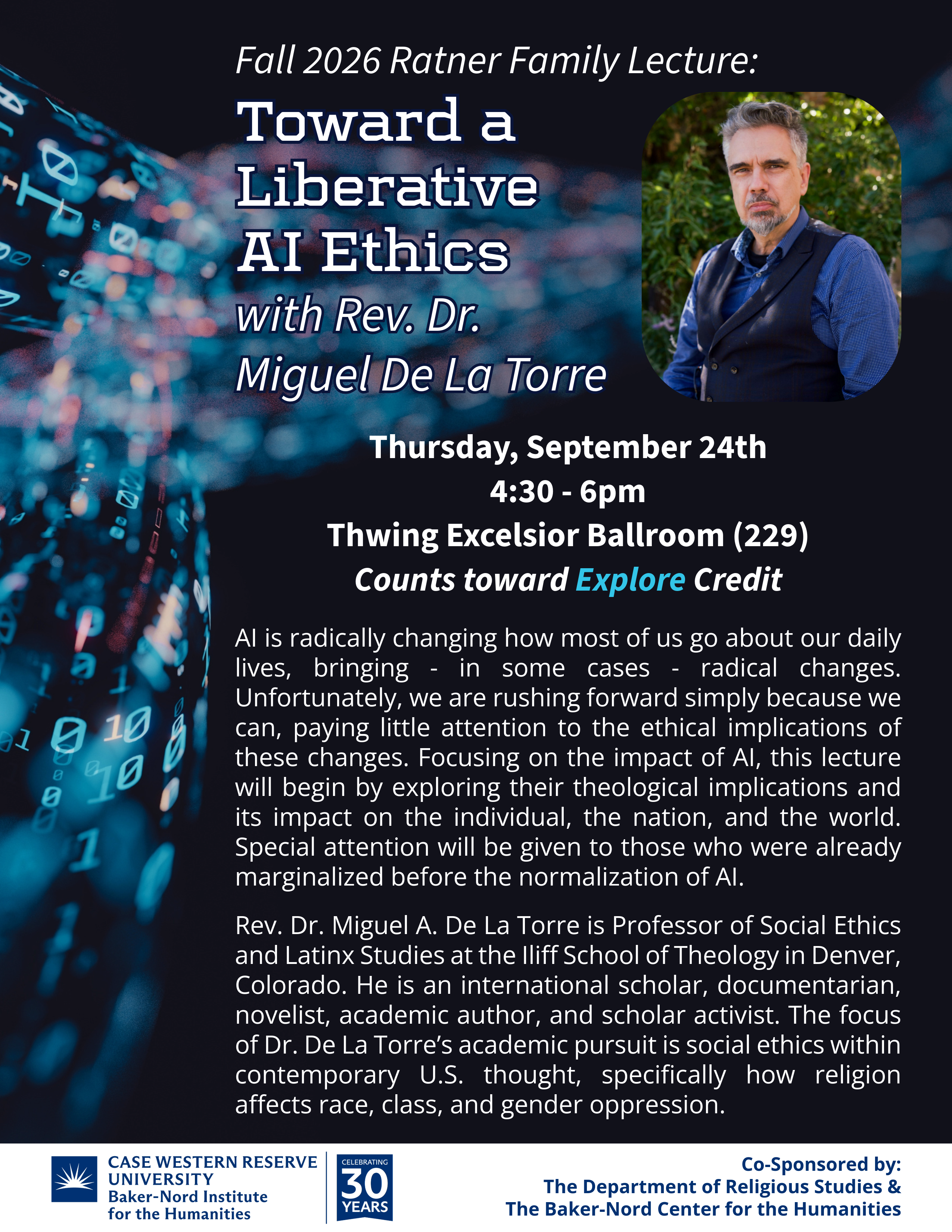
Ratner Family Lecture 2026
The Department of Religious Studies welcomes guest lecturer Rev. Dr. Miguel De La Torre to deliver the Bi-Annual Ratner Family Lecture, “Toward a Liberative AI Ethics.”
Co-sponsored by the Department of Religious Studies and The Baker-Nord Center for the Humanities
Thursday, September 24th
4:30 pm – 6 pm
Thwing Excelsior Ballroom (229)
Counts toward Explore Credit – Register Today!
AI is radically changing how most of us go about our daily lives, bringing – in some cases – radical changes. Unfortunately, we are rushing forward simply because we can, paying little attention to the ethical implications of these changes. Focusing on the impact of AI, this lecture will begin by exploring their theological implications and its impact on the individual, the nation, and the world. Special attention will be given to those who were already marginalized before the normalization of AI.
Rev. Dr. Miguel A. De La Torre is Professor of Social Ethics and Latinx Studies at the Iliff School of Theology in Denver, Colorado. He is an international scholar, documentarian, novelist, academic author, and scholar activist. The focus of Dr. De La Torre’s academic pursuit is social ethics within contemporary U.S. thought, specifically how religion affects race, class, and gender oppression.
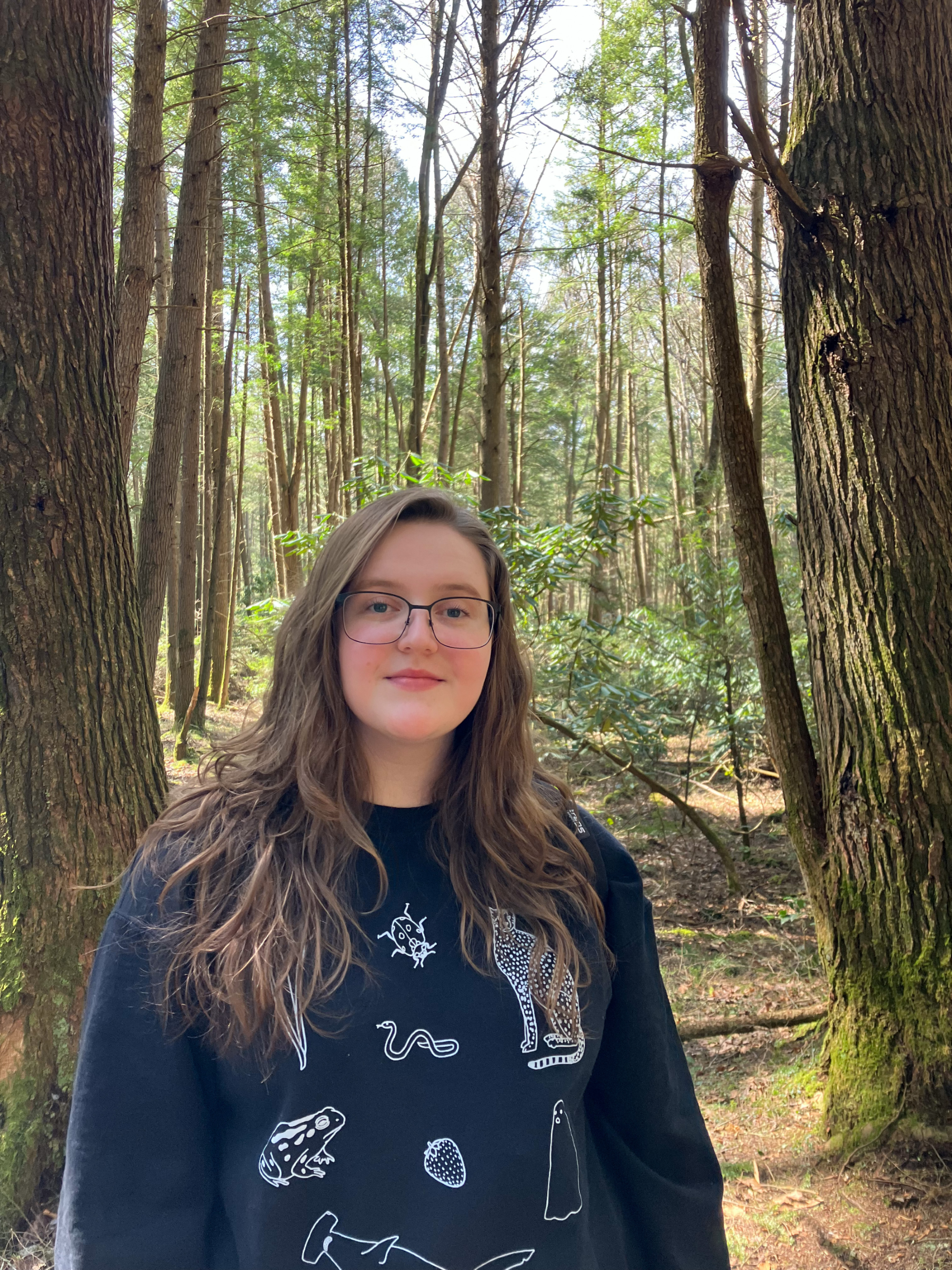
Recent Graduate, Patricia Carrig, published in the UCLA Journal of Religion
Patricia Carrig, a 2025 graduate of CWRU, has been published in the UCLA Journal of Religion’s seventh volume for her Capstone project, “The Final Girl? Or The Primal Androgyne? An Exploration of the Connections Between a Slasher Film Trope and Genesis I & II.” Since graduating with majors in Environmental Geology and Environmental Studies and a minor in Religious Studies, Patricia has joined the Colman Lab in the Department of Earth, Environmental, and Planetary Sciences as a research assistant, where she investigates sources of air pollution in Cleveland and their effects on urban health.
Patricia’s interest in the intersection of film and religion grew during her undergraduate years, when she became deeply involved in student filmmaking and explored courses in film studies alongside her religious studies coursework. Her paper examines the connections between Carol J. Clover’s influential “Final Girl” trope in slasher films and concepts of the primal androgyne and spiritual androgyny found in early Christian thought, as discussed by scholar Daniel Boyarin in his analysis of the writings of Philo of Alexandria. Reflecting on the project, Patricia noted her long-standing fascination with the shared focus on myth and ritual found in both film studies and religious studies. Her research demonstrates how interdisciplinary perspectives can reveal unexpected connections between popular culture and religious traditions.
Congratulations to Patricia on this outstanding achievement and publication!
Highlights
Reisacher Summer Fellowship
Up to $3,000 in Summer Funding for Students in Religious Studies
Applications for the annual Reisacher Summer Fellowship are due Wednesday, April 1st 2026. To apply, complete the application cover sheet and additional requirements, then send to jesse.friedman@case.edu
Winners will be announced Friday, May 1st 2026. Good Luck!