
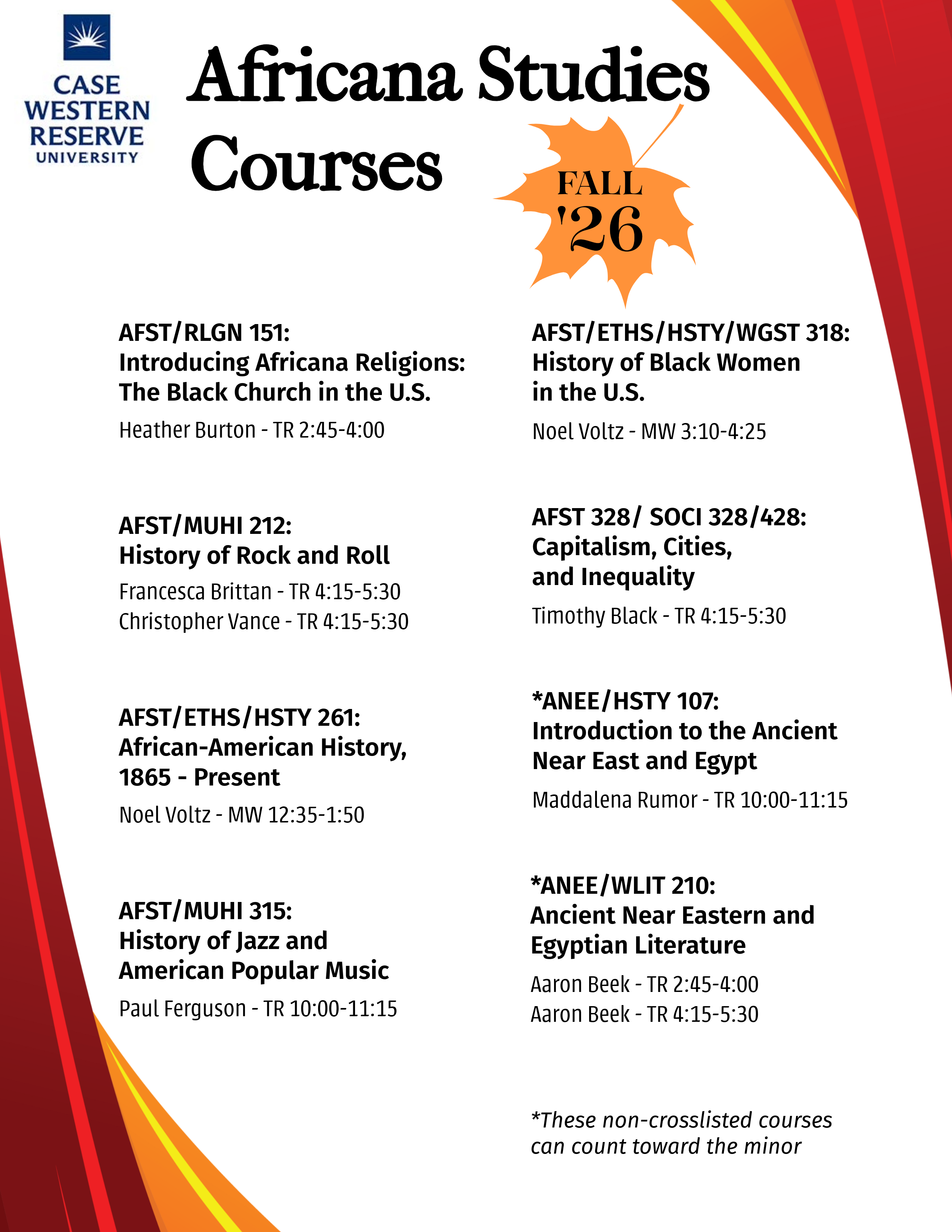
AFST/RLGN 151: Introducing Africana Religions – The Black Church in the U.S.
Heather Burton – TR 2:45-4:00
This “topics course” offers an introduction to the academic study of Africana Religions. Whether approached through a particular theme or as a general historical introduction, each section of this course provides students with a general introduction to the academic study of religion and basic religious literacy in religions of people of African origins in sub-Saharan African, the Caribbean, Europe, and the Americas and thus will explore forms of these traditions in a diversity of cultural contexts. Section topics could include, but are not limited to: Introducing Africana Religions: The Black Church in the U.S., Introducing Africana Religions: Yoruba Ifa Traditions, Introducing Africana Religions: Orisha Traditions in Latin America and the Caribbean, Introducing Africana Religions: African American Religions, Introducing Africana Religions: U.S. African-derived Religions. Students may repeat the course for credit (up to 6 credits), provided that the two sections are different.
Skill: Communication Intensive
Perspectives:
- Understanding Global Perspectives
- Human Diversity and Commonality
AFST/MUHI 212: History of Rock and Roll
Francesca Brittan – TR 4:15-5:30
Christopher Vance – TR 4:15-5:30
This course surveys the music and culture of the rock and roll era, broadly defined to include much popular music since the 1950s to the present day. Music majors are to enroll in MUHI 312.
Perspective: Human Diversity and Commonality
AFST/ETHS/HSTY 261: African-American History, 1865 – Present
Noel Voltz – MW 12:35-1:50
This course examines the African American experience from emancipation to the present. The history of African peoples in the United States has primarily been a chronicle of strivings for liberation, justice, and equality. Much of this story represents Black people’s desires to retain their racial identity and autonomy, to build community, and create a sense of nationalism, while simultaneously asserting their right to be treated as equal American citizens. During this course, student will gain insight into the conditions of life for people of African descent in America while also being introduced to the myriad ways in which African Americans have continually pushed for freedom. This course will discuss a variety of themes in African American history including slavery and freedom, politics, resistance, gender, culture, identity, economy, etc. The specific topics explored include: Reconstruction, the Racial Nadir, the New Negro Movement, Black Radicalism in the Depression Era, The Civil Rights and Black Power Movements, Black Feminism, Black Politics in the 1980s, and finally, the state of Black America in the New Century with particular emphasis placed on contemporary topics including mass incarceration and the rise of the #BlackLivesMatter Movement.
Throughout the course, students will be exposed to lectures, readings, films, and class discussion that will enable them to analyze the impact of various forms of human difference on lived experiences and individual and collective choices made by black folks throughout American history.
Perspective: Human Diversity and Commonality
AFST/MUHI 315: History of Jazz and American Popular Music
Paul Ferguson – TR 10:00-11:15
Musical styles and structures of jazz and American popular music; emphasis on music since 1900. Recommended preparation: MUTH 202, MUTH 211, or MUHI 202.
Perspective: Human Diversity and Commonality
AFST/ETHS/HSTY/WGST 318: History of Black Women in the U.S.
Noel Voltz – MW 3:10-4:25
This course focuses on the history of black women in the United States. Moving from enslavement to the present, this course is designed to give you an overview of the lived experiences of women of African descent in this country. This course will focus on themes of labor, reproduction, health, community, family, resistance, activism, etc., highlighting the diversity of black women’s experiences and the ways in which their lives have been shaped by the intersections of their race, gender, sexuality, and class. Throughout the course, students will be exposed to lectures, readings, films, and class discussion that will enable them to analyze the impact of various forms of human difference on lived experiences and individual and collective choices made by black women throughout American history.
Perspective: Human Diversity and Commonality
AFST 328/ SOCI 328/428: Capitalism, Cities, and Inequality
Timothy Black – TR 4:15-5:30
This course focuses on social inequality, but through an examination of cities in the U.S. and abroad. In many ways, cities provide a window onto the organization of the larger social world, including regional, state, national and global areas. As such, understanding cities goes far beyond their geographical boundaries. The purpose of this course then is to learn the central role that cities play within a larger capitalist economy, how public policies shape life in cities, how cities organize and reproduce social inequality, and how community groups and organizations challenge and negotiate the organization of power and inequality. The course will examine topics such as the formal and informal labor force, immigration, the growth of global cities and slums, urban poverty, racial segregation, housing and homelessness, crime, gentrification, policing, community organization and political resistance.
Perspectives:
- Understanding Global Perspectives
- Human Diversity and Commonality
ANEE/HSTY 107: Introduction to the Ancient Near East and Egypt
Maddalena Rumor – TR 10:00-11:15
This course introduces students to the history and culture of the Ancient Near East and Egypt, a region spanning from modern Iraq to Egypt that was home to the earliest known societies in written history. These include the Babylonian, Assyrian, and Egyptian empires, as well as other Levantine and Anatolian powers and smaller nations such as Israel. Students will learn about the relatively recent discoveries concerning these ancient civilizations, including their political, social, literary, scientific, artistic, and religious achievements, as well as their cultural legacy.
Perspectives:
- Understanding Global Perspectives
- Human Diversity and Commonality
ANEE/WLIT 210: Ancient Near Eastern and Egyptian Literature
Aaron Beek – TR 2:45-4:00 and TR 4:15-5:30
This course offers a broad survey of Ancient Near Eastern and Egyptian literature. We will explore the rich heritage of narrative and mythological compositions through which the Mesopotamians and Egyptians tried to explain the natural phenomena, the religious beliefs and the history of the world around them. Examples of this include myths of creation, stories about gods, the great Flood, the Epic of Gilgamesh, the story of Sinuhe and many others. Other genre of literature will be explored such as the most ancient Legal Codes in history, Pyramid Texts, Wisdom Literature and Proverbs, Love Poetry and Humoristic compositions. Finally, some time will be devoted to the relation of these literatures with the texts that were composed in the Levant, where the alphabet was envisioned, and with the Bible, which grew within this Near Eastern context. All the texts will be read in English translation.
Skills: Communication Intensive
Perspectives: Understanding Global Perspectives