
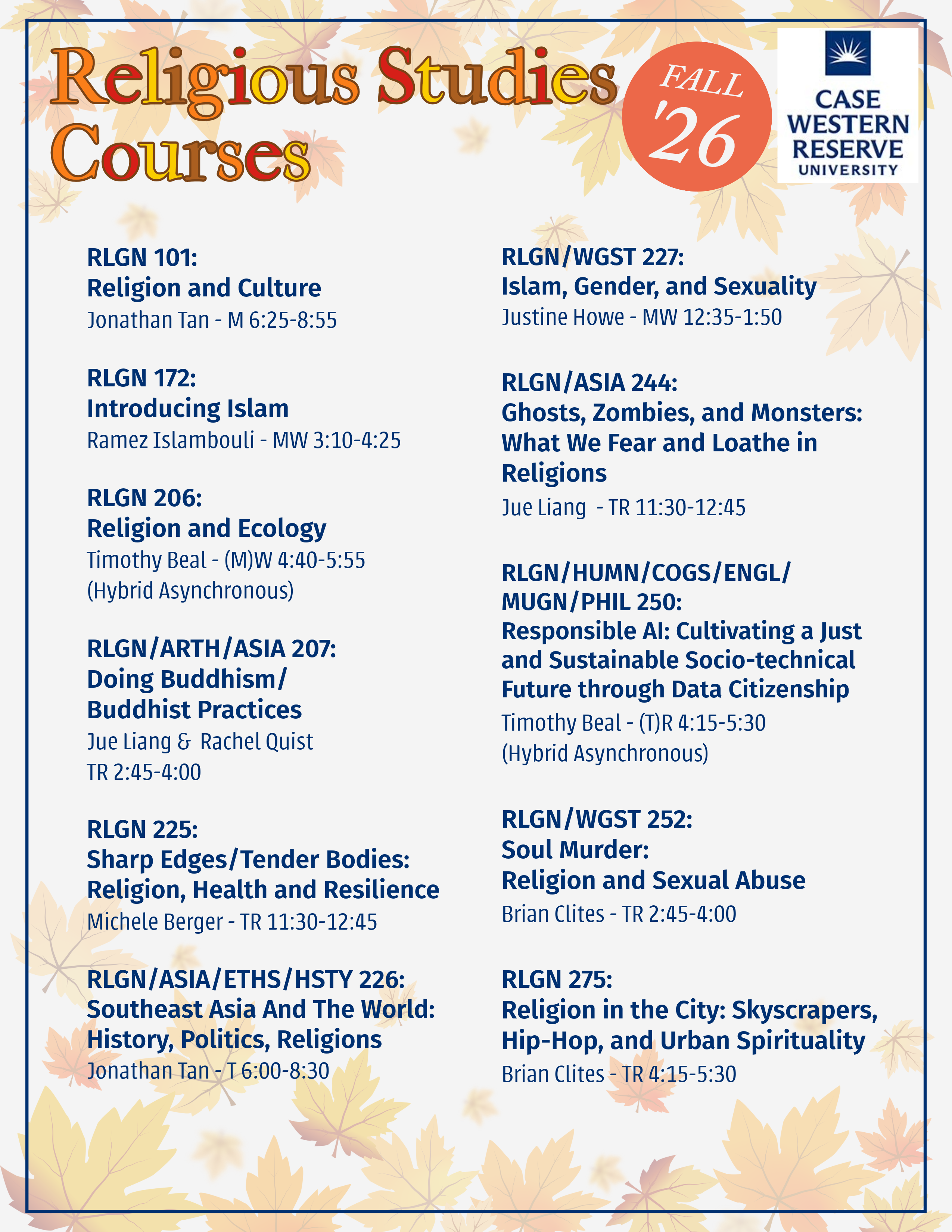
RLGN 101: Religion and Culture
Jonathan Tan – M 6:25-8:55
This course introduces students to the study of religion by examining religious practices within a variety of cultural and historical contexts around the world. The course invites students to think comparatively and critically about the role of religion within broader cultural discourses (e.g., gender, politics, and the environment).
Instead of surveying what were formerly called the “world’s great religions,” this course builds religious literacy by examining religious practices within particular geographical and thematic areas. Through comparative case studies drawn from a diverse range of “non-western” cultures, students will learn about religions and spiritualities across the globe. These cultural touchstones will build core literacy in other cultures, positioning students to engage more fully in the religious and cultural diversity that they will encounter in their own lives and careers.
Alongside these geographic case studies, the course will also examine key themes in the study of religion, such as diasporic transnationalism, liberation theology, and ritual practice. We will use these themes to tease out and debate some of the core theoretical and methodological challenges in the study of religion, including postcolonial critiques of the origin and history of the field of religious studies itself.
To be clear, religion is our subject, not our approach. Although students will find opportunities to reflect on their own spirituality/disbelief, the course does not presume any particular religious or non-religious perspective. Indeed, the study of religion is itself concerned not only with the world’s religious traditions, but also with contemporary questions of skepticism, science, disbelief, and secularity.
Evaluation will be based on class preparation and participation, regular short papers, a midterm exam, and a final take-home essay exam.
Perspectives:
- Moral and Ethical Reasoning
- Understanding Global Perspectives
- Human Diversity and Commonality
RLGN 172: Introducing Islam
Ramez Islambouli – MW 3:10-4:25
This course is an introduction to the beliefs, practices, sacred texts, and intellectual traditions of Islam. We will approach the many dimensions of Islam from the perspective of religious studies. Our goal is to develop a foundational understanding of the core aspects of Islam, while exploring the scholarly approaches to the study of Muslim belief, practices, and communities. Throughout the term, we will examine major developments in the history of Islam, underscoring the dynamic changes that the tradition has undergone in its 1400+ year history and in various cultural contexts in West Africa, the Middle East, South Asia, and China.
Skill: Communication Intensive
Perspective: Understanding Global Perspectives
RLGN 206: Religion and Ecology
Timothy Beal – (M)W 4:40-5:55
(Hybrid Asynchronous)
Cross-religious and cross-cultural introduction to the interdisciplinary field of religion and ecology. Ecological ideas and practices from Indigenous religions, South and East Asian religions, and monotheistic religions will be examined and compared as they relate to ecology and environmental ethics in our contemporary context. Themes include: climate crisis and climate justice in the Anthropocene, human exceptionalism, ideas of the wilderness, human-animal relations, and ecological interdependence.
Perspectives:
- Moral and Ethical Reasoning
- Understanding Global Perspectives
- Human Diversity and Commonality
RLGN/ARTH/ASIA 207: Doing Buddhism/Buddhist Practices
Jue Liang & Rachel Quist – TR 2:45-4:00
Contrary to the popular belief that Buddhists eschew worldly possessions, the rich practical tradition in Buddhism reveals a world of textual and visual materials. By embracing the roles these objects play in various Buddhist contexts, this course explores the reciprocal relationship between things and actions. How do practitioners interact with material cultures, such as scriptures, icons, and architecture? And what modes of practice do these objects inspire in turn?
With a chronologically grounded structure that traces how Buddhism developed across Asia, the course takes a thematic approach to these questions. We begin by introducing the earliest examples of textual and visual practices before expanding into units that explore how Buddhism changed across time and space. In this course, students will engage with many modes of experiential learning within the classroom and beyond. In addition to attending in-class lectures and discussions, students will analyze the Cleveland Museum of Art’s expansive collection of Buddhist texts and images through visits to the galleries, Art Study Room, and Educational Art Collection. In this Communication Intensive course, students will hone their critical and creative analytic skills by developing an original research project in consultation with their professors.
Skill: Communication Intensive
Perspectives:
- Understanding Global Perspectives
- Human Diversity and Commonality
RLGN 225: Sharp Edges/Tender Bodies: Religion, Health, and Resilience
Michele Berger – TR 11:30-12:45
This course examines how women of color understand, negotiate, and practice health through religious belief, spirituality, and embodied knowledge. Through interdisciplinary texts, narratives, and case studies, students explore how faith traditions shape experiences of illness, healing, wellness, activism, and care in the context of race, gender, and power.
Perspective: Human Diversity and Commonality
RLGN/ASIA/ETHS/HSTY 226: Southeast Asia and the World: History, Politics, Religions
Jonathan Tan – T 4:00-6:30
This course explores the background and factors contributing to the development and shaping of contemporary Southeast Asia, as well as the intersection and synthesis of the social, cultural, geographical, religious, and political dimensions by placing ordinary lives within the context of emerging postcolonial nation states in Southeast Asia. It analyzes major trends and transformations across the whole Southeast Asia region during different historical periods — the conquest of traditional kingdoms, colonial rule, the impact of World War II, nationalist revolutions, and the emergence of new postcolonial nations. More broadly, it also examines the intersection and synthesis of the social, cultural, geographical, religious, and political dimensions by placing the ordinary lives of Southeast Asian peoples within the context of emerging postcolonial nation states. At the end of the course, students will gain a firm foundation in acquiring a foundational knowledge in the history, religion, culture, geography, and society of Southeast Asia, as well as understanding the implications of the continuing socio-cultural, economic, and political transformation of contemporary Southeast Asia and the significance that this region has for the rest of the world.
Perspectives:
- Understanding Global Perspectives
- Human Diversity and Commonality
RLGN/WGST 227: Islam, Gender, and Sexuality
Justine Howe – MW 12:35-1:50
Gender and sexuality are central to understanding Muslim societies, past and present. From debates about the veil to the wars in Iraq and Afghanistan, gendered concerns have been especially prominent in contemporary debates about Islam in the modern world. How are masculinity and femininity constructed in Muslim contexts? How have Muslim thinkers interpreted Islamic scriptures with respect to topics such as marriage, child custody, inheritance, and sexuality? In what ways do these interpretations reflect the political, economic, and social conditions in which they lived? How does gender structure authority and power in Muslim communities? How and why have Muslim women become so central to contemporary political debates?
This course explores each of these questions, while inviting students to construct alternative narratives around Islam, gender, and sexuality. This course begins by examining gender and sexuality in the foundational Islamic texts, the Qur’an and Sunna (the practice of the Prophet Muhammad), and pre-modern interpretations of these texts. The course then turns to marriage and divorce in Muslim jurisprudence, in order to examine themes such as women’s spiritual capacities, female leadership, sexuality, and slavery. Next, we will turn to the headscarf as a lens though which to explore modern configurations of gender and sexuality, as they intersect with conceptions of national belonging, religious identity, and individual freedom. Finally, we will study contemporary debates over polygyny, LGBTQ+ identities, and female religious authority.
There are no prerequisites for this course. No prior knowledge of Islam is expected.
Skill: Communication Intensive
Perspectives:
- Moral and Ethical Reasoning
- Understanding Global Perspectives
- Human Diversity and Commonality
RLGN 244: Ghosts, Zombies, and Monsters: What We Fear and Loathe in Religions
Jue Liang- TR 11:30-12:45
Our religious imaginations are constantly haunted by myriad frightening and loathsome beings. In this class, we will explore the many ways in which ghosts, zombies, and monsters have symbolized and personified the issues, concerns, hopes, and fears that have shaped our lives. Combining the two threads of eschatology (theological considerations about death and “the end”) and monster theory, it brings to the fore what is commonly demonized, marginalized, or unseen in religious traditions across the globe and asks what it is about the ghosts, zombies, and monsters that appalls and arrests us.
To understand the diverse cultural traditions and their imagination of ghosts, zombies, and monsters, the majority of the course content is dedicated to these fearsome beings in Asian contexts — China, Japan, Tibet, Thailand, to name a few.
Perspectives:
- Understanding Global Perspectives
- Human Diversity and Commonality
RLGN/HUMN/COGS/ENGL/MUGN/PHIL 250: Responsible AI: Cultivating a Just and Sustainable Socio-technical Future through Data Citizenship
Timothy Beal – (T)R 4:15-5:30
(Hybrid Asynchronous)
An introduction to the key issues that inform ethically responsible design, deployment, and use of artificial intelligence (AI) technologies, with particular focus on the impact of data practices. From generative language models to video surveillance and identity detection to facial recognition, AI is becoming more and more embedded in our everyday lives. These AI technologies are increasingly built on our data, whether we are aware of it or not. In this praxis-oriented course, we will explore how data is fundamental to the development of AI technologies and develop practices for increased awareness of and participation in this data ecosystem. As we interrogate AI systems in everyday life through hands-on engagement with AI tools and their data pipelines, we will begin to construct a data citizenship model that can help us reclaim the power of collective responsibility in order to build a more just and sustainable socio-technical future. Students will focus their individual and group projects on questions and issues directly related to the subject area of the offering they are enrolled in.
Perspective: Moral and Ethical Reasoning
RLGN/WGST 252: Soul Murder: Religion and Sexual Abuse
Brian Clites – TR 2:45-4:00
“Soul murder” is a term that psychologists and survivors use to describe the way that clergy sexual abuse destroys a child’s network of relationships. In addition to sexual, developmental, and psychological harm, victims of religious abuse also experience intense theological, moral, and familial suffering. This course analyzes these topics through religious, legal, medical, and anthropological case studies. What are the cultural, racial, and gendered dynamics of religious abuse? How is it different than sexual assault in non-religious contexts? How has abuse shaped Christian and Hindu sexual ethics? These are some of the questions that you will be able to answer by the end of this seminar.
Perspectives:
- Moral and Ethical Reasoning
- Human Diversity and Commonality
RLGN 275: Religion in the City: Skyscrapers, Hip-Hop, and Urban Spirituality
Brian Clites – TR 4:15-5:30
“Religion in the City” examines how immigration, globalization, and diaspora have reshaped the social and spiritual landscape of American cities, with an emphasis on African, Asian, and Latin American religions. Through case studies, we will examine the complex and sometimes-contested interplay of multiple religious influences within the urban boundaries of historic neighborhoods in Boston, New York, Chicago, Los Angeles, Miami, and Cleveland.
Skill: Communication Intensive
Perspectives:
- Understanding Global Perspectives
- Human Diversity and Commonality