
For the entire Africana Studies course catalog, and full course descriptions, please see Department of Religious Studies < Case Western Reserve University
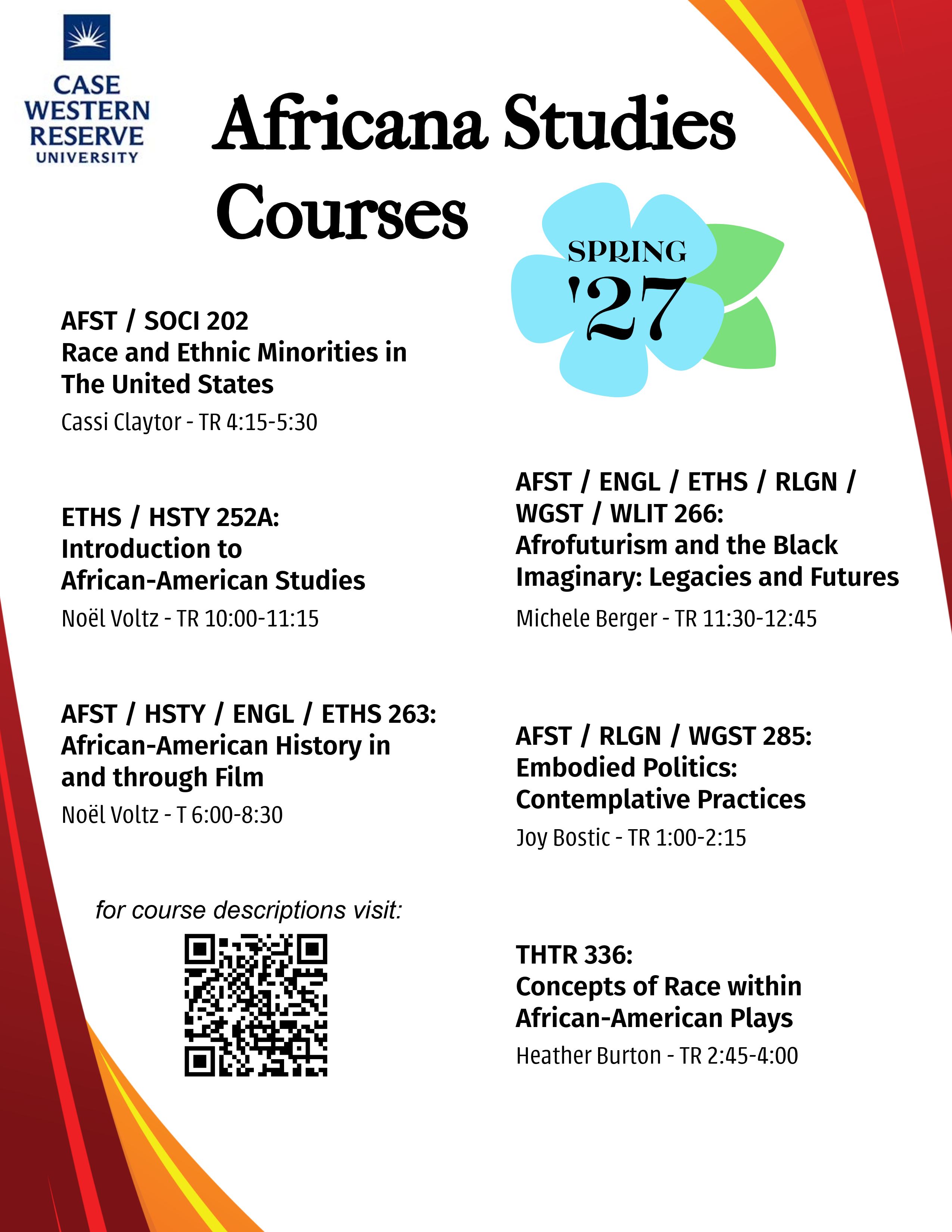
AFST / SOCI 202 Race and Ethnic Minorities in The United States
Cassi Claytor – TR 4:15-5:30
This course explores interactions between racial and ethnic majority and minority groups in the United States. We examine the historical origins and formation of racial/ethnic hierarchies, the institutional and normative processes for reproducing these hierarchies, and the social and economic significance of stratified racial and ethnic group identities. The course is taught from a macro perspective that examines larger structural forces (e.g., colonization, slavery, and immigration) to explain inter-group relations, and a constructionist perspective to understand the way that power fashions the social meaning of identities (e.g., symbolic violence and hegemonic discourse), social categories (e.g., panethnic Asian and Hispanic groups), and everyday interactions (e.g., stereotypes and white racial frame). Specific topics include the formation and significance of white and black identities, reactive ethnicity, the racial privilege of whiteness, the politics of immigration, and the intersectionality of class, race and gender.
Perspectives:
- Moral and Ethical Reasoning
- Human Diversity and Commonality
AFST / HSTY / ENGL / ETHS 263: African-American History in and through Film
Noël Voltz – T 6:00-8:30
This course focuses on the history of black representation in film and television in the United States. In this course, students will be introduced to some of the earliest representations of Black folks on the silver screen as well as learn about emergence of Black cinema (black films made for, by and about Black people) in the 20th century. Through this exploration, students will become acquainted with some of the most significant films, actors, and directors in African American history. This course will also teach students how to critically analyze how African American history has been depicted in modern and popular “historical” films. Students will be encouraged to employ the analysis skills and particularly critical theories of race, gender, and class to examine how filmmakers have presented, and too often distorted, historical events related to the Black experience in the United States. Finally, throughout the course, students will be encouraged to think about the ways in which films and television, both in the past and present, have contributed to the constructions of race and racial stereotypes in the United States. Films and documentaries will serve as some of the major “texts” of this course. Students will be screenings films both at home and in class.
Perspective: Human Diversity and Commonality
AFST / ETHS / HSTY 252A: Introduction to African-American Studies
Noël Voltz – TR 10:00-11:15
This course is designed to introduce students to the study of Black History, cultures, economics, and politics. Students will learn about the development of the field by exploring theoretical questions, methodological approaches, and major themes that have shaped the study of black people, primarily in the U.S. context. This is a seminar-style, discussion-based course that emphasizes critical analysis and expository writing.
AFST / ENGL / ETHS / RLGN / WGST / WLIT 266: Afrofuturism and the Black Imaginary: Legacies and Futures
Michele Berger – TR 11:30-12:45
This course explores the theoretical, literary and cultural expressions of Afrofuturism. The term Afrofuturism was developed in 1993 by scholar Mark Dery and is an all-encompassing term used to describe creative work – literature (especially science fiction), music, art – that focuses on Afro-diasporic ways of being and knowing. The course explores the multiple meanings and expressions of Afrofuturism and how it expands various literary traditions. Traditional speculative fiction canons have often distorted and/or erased the existence of people of color in the future. This course recenters these experiences. Readings will delve into the legacies of slavery, colonialism, entrenched inequalities to understand their impact on real and imagined technological futures. Students will spend time exploring how Afrofuturist writers and cultural workers imagine new possibilities that expand our sense of liberation and justice. Recommended preparation: Academic Inquiry Seminar (AIQS) or SAGES First Seminar.
Skill: Communication Intensive
Perspective: Human Diversity and Commonality
AFST / RLGN / WGST 285: Embodied Politics: Contemplative Practices
Joy Bostic – TR 1:00-2:15
The incorporation of contemplative practices (e.g. yoga, sitting and walking meditation, mindfulness, ceremony, pilgrimage, etc.) in civil and social justice movements is a growing trend. Scholars and activists, especially those interested in racial and gender equity, over the past two decades have raised interest in a broad set of contemplative practices that can address suffering and social justice issues in teaching, research and activism. What role does contemplative practices and spiritual activism play in efforts for social justice and social change? What might practices of social transformation look like when rooted in love and compassion? This course explores these questions among others, and examines the role of contemplative practices and spirituality for individuals and collectivities engaged in transformative social justice work.
We explore the increasing incorporation of contemplative practices and ‘self-recovery’ approaches into current social justice movements including Black Lives Matter, indigenous land claims, feminism, LGBTQ rights, etc. In turn, we also examine how activists bring new insights and questions to traditional practices and use practices rooted in decolonizing efforts. In particular, we focus on the work of contemporary feminist, womanist and women of color scholars and activists. We also explore the writings and practices of contemplative practices from a range of traditions.
Skill: Full-Semester Wellness/Non-movement
Perspective: Human Diversity and Commonality
THTR 336: Concepts of Race within African-American Plays
Heather Burton – TR 2:45-4:00
This course provides an interdisciplinary study of race and African Americans within the context of African American plays. It will use the basic principles of African and African American history, urban studies, theater, sociology, economics and family life, etc. to identify aspects of race and racism. The course will provide an overview of race and racism in America through the lens of African American plays. The semester long course will analyze and discuss a conceptual understanding of how aspects of race serve as central themes within African American plays. The course will engage in various theories, discussions and debates about the African American experience and the relationship to race and racism displayed within the context of plays.