
For the entire Religious Studies course catalog, and full course descriptions, please see Department of Religious Studies < Case Western Reserve University
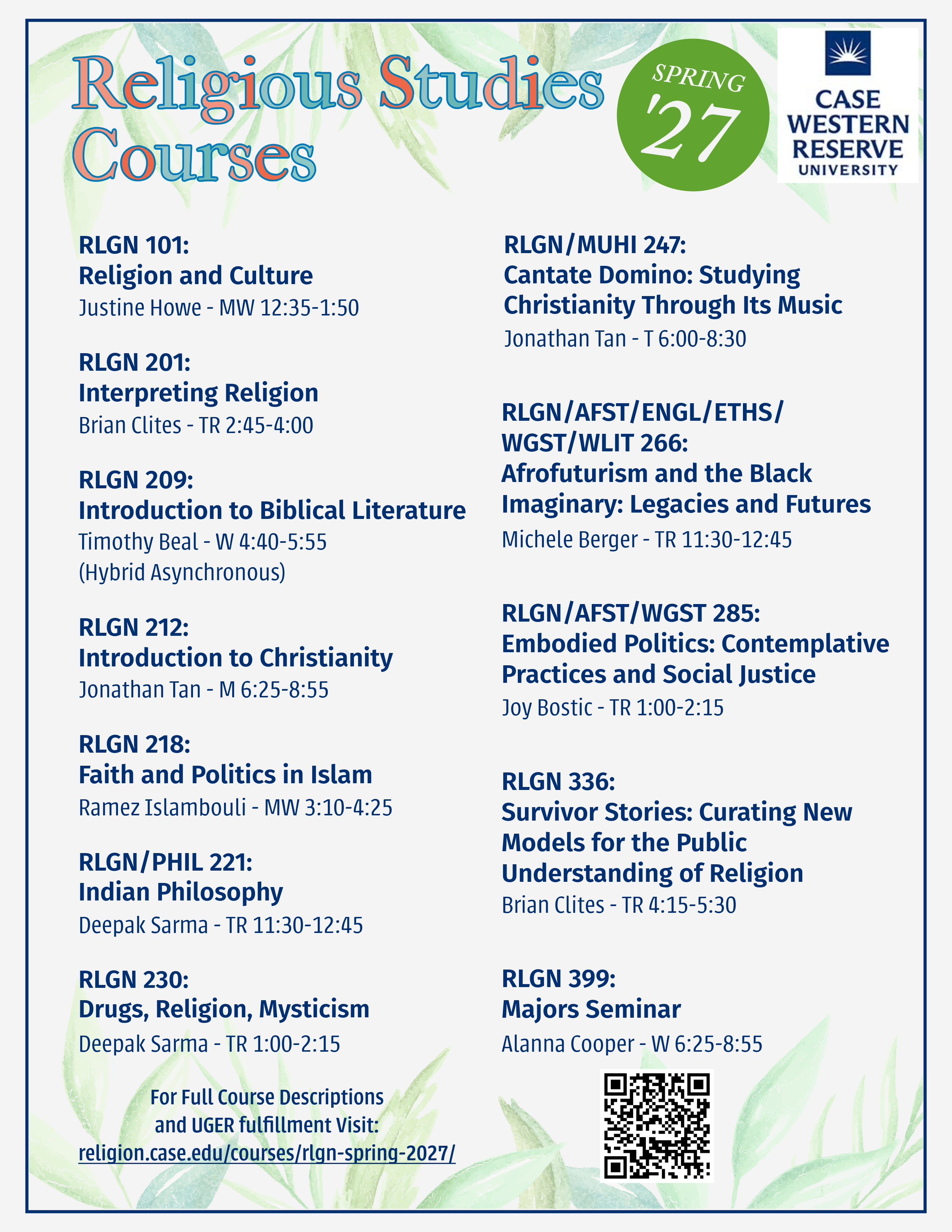
RLGN 101: Religion and Culture
Justine Howe – MW 12:35-1:50
This course introduces students to the study of religion by examining religious practices within a variety of cultural and historical contexts around the world. The course invites students to think comparatively and critically about the role of religion within broader cultural discourses (e.g., gender, politics, and the environment). Instead of surveying what were formerly called the “world’s great religions,” this course builds religious literacy by examining religious practices within particular geographical and thematic areas. Through comparative case studies drawn from a diverse range of “non-western” cultures, students will learn about religions and spiritualities across the globe. These cultural touchstones will build core literacy in other cultures, positioning students to engage more fully in the religious and cultural diversity that they will encounter in their own lives and careers. Alongside these geographic case studies, the course will also examine key themes in the study of religion, such as diasporic transnationalism, liberation theology, and ritual practice. We will use these themes to tease out and debate some of the core theoretical and methodological challenges in the study of religion, including postcolonial critiques of the origin and history of the field of religious studies itself. To be clear, religion is our subject, not our approach. Although students will find opportunities to reflect on their own spirituality/disbelief, the course does not presume any particular religious or non-religious perspective. Indeed, the study of religion is itself concerned not only with the world’s religious traditions, but also with contemporary questions of skepticism, science, disbelief, and secularity. Evaluation will be based on class preparation and participation, regular short papers, a midterm exam, and a final take-home essay exam.
Perspectives:
- Human Diversity & Commonality
- Moral & Ethical Reasoning
- Understanding Global Perspectives
RLGN 201: Interpreting Religion
Joy Bostic – TR 1:00 – 2:15
Introduction to academic study of religion, exploring the history and development of the field, important theories and methodologies, and current issues, debates, and horizons of research. This course provides students with the opportunity to approach the global study of religion from an interdisciplinary perspective. It pays particular attention to how religious studies has approached the study of non-Western cultures and religions and provides students with the opportunity to reflect on their own assumptions about “religion” as a category. This course also engages students around comparative questions in relation to religions in Asia and Africa, in order to develop critical, yet empathetic approaches to the comparison of global religions through key terms in religious studies such as ritual, belief, myth, and authority.
The course is foundational for majors and minors in religious studies but also open to other interested students who may find it valuable for their work in other fields of study. Particular readings and other assignments will be determined by the designated instructor. Students are expected to attend class regularly, complete readings and other assignments, and participate actively in class discussions and other activities.
Skill: Disciplinary Communication
Perspective: Understanding Global Perspectives
RLGN 209: Introduction to Biblical Literature
Timothy Beal – W 4:40-5:55 (Hybrid Asynchronous)
This course is an introduction to the academic study of biblical literature, including Hebrew Scriptures (“Old Testament”) and the New Testament. The literature will be studied in light of both ancient and contemporary historical contexts, with a particular emphasis on the roles it plays in American culture and politics today. Class sessions will be discussion oriented and will involve close, careful analysis and interpretation of texts. No background in religion is necessary. Evaluation will be based on class preparation and participation, regular short writing assignments, two exams, and a major paper.
Skill: Communication Intensive
Perspective: Human Diversity & Commonality
RLGN 212: Introduction to Christianity
Jonathan Tan – M 6:25-8:55
This course introduces students to the emergence and historical developments of Christianity from its Jewish sectarian roots to a global religion, focusing on how the central doctrinal-theological and moral-ethical themes of the Christian tradition have emerged and developed in different ecclesial traditions of transnational Christianity — Orthodox and Oriental Orthodox, Catholic and Mainline Protestant, Evangelical and Renewal. It explores how the forces of cultural diversity and pluralism, historic colonialism and imperialism, globalization and migration, as well as contemporary postcolonial and transnational consciousness shape and challenge the trajectory of the growth and spread, as well as the socio-political transformation of Christianity from its Mediterranean roots across the globe over two millennia. It discusses the broader socio-cultural, philosophical-theological, moral-ethical, and political dimensions emerging from the Christian tradition generally, as well as evaluates the themes of community building, identity formation and constructions, moral-ethical codes, and social movements within the different ecclesial traditions of Christianity, their contributions on ongoing theological conversations and moral-ethical debates, as well as their contemporary significance and long term global and transnational implications of Christianity as a global religion.
Perspectives:
- Human Diversity & Commonality
- Moral & Ethical Reasoning
RLGN 218: Faith and Politics in Islam
Ramez Islambouli – MW 3:10-4:25
An overview of the relationship between Islam as a religion and Islam as a political system and the effect of this relationship on Islamic society from its origin to the present time.
RLGN/PHIL 221: Indian Philosophy
Deepak Sarma- TR 11:30-12:45
We will survey the schools of Indian philosophy. Our concern will be the methods, presuppositions, arguments, and goals of these schools and their trajectories of thought. What were their theories on the nature of the person, the nature of reality (ontology), the nature and process of knowing (epistemology), and the right cognitive habits needed for breaking out of the cycle of birth/rebirth? What were the debates between the schools and the major points of controversy? And, most importantly, are the positions/arguments internally (in)coherent? The class will focus on intellectual cultures outside the United States. It will address in a substantive way ethnic, gender, sexual, philosophical, religious, or other cultural practices outside the United States, to provide students with new perspectives on their own cultural assumptions, traditions, and experiences. It will also address the examines the complexities of socially/humanly constructed categories.
Skill: Communication Intensive
Perspectives:
- Human Diversity & Commonality
- Moral & Ethical Reasoning
- Understanding Global Perspectives
RLGN 230: Drugs, Religion, and Mysticism
Deepak Sarma – TR 1:00-2:15
This class examines the relationship between drugs, religion/ religious traditions, and mystical experiences. While many religious traditions prohibit the use of alcohol, tobacco, or other drugs, many advocate the use of substances to achieve desired cognitive states, for spiritual or even medical/ therapeutic purposes. The class will look at several case studies, scientific papers, and philosophical monographs that pertain to, or provoke, these complexities. In this way we will problematize the categories “drug,” “religion,” and “mystical experience.” We will look at cases from Asia, South America, and Mexico.
Perspectives:
- Human Diversity & Commonality
- Understanding Global Perspectives
RLGN/MUHI 247: Cantate Domino: Studying Christianity Through Its Music
Jonathan Tan – T 6:00-8:30
This interdisciplinary seminar explores the complex intersecting relationships between Christian church history, formation and development of church traditions, faith and identity construction of their congregants through the lens of Christian music, past and present. It explores the history and development of Christian music within the social, cultural, regional, ritual, and spiritual contexts that inspired their emergence and growth. While the primary approach in this seminar is historiographical with attention on Christian music which emerged and developed in Europe and North America, ethnomusicological principles may be utilized where appropriate to examine contemporary genres of Christian music from the Two-Thirds or Majority World.
Prereq: Academic Inquiry Seminar (AIQS).
Skill: Communication Intensive
Perspectives:
- Human Diversity & Commonality
- Understanding Global Perspectives
RLGN/AFST/ENGL/ETHS/WGST/WLIT 266: Afrofuturism and the Black Imaginary: Legacies and Futures
Michele Berger – TR 11:30-12:45
This course explores the theoretical, literary and cultural expressions of Afrofuturism. The term Afrofuturism was developed in 1993 by scholar Mark Dery and is an all-encompassing term used to describe creative work – literature (especially science fiction), music, art – that focuses on Afro-diasporic ways of being and knowing. The course explores the multiple meanings and expressions of Afrofuturism and how it expands various literary traditions. Traditional speculative fiction canons have often distorted and/or erased the existence of people of color in the future. This course recenters these experiences. Readings will delve into the legacies of slavery, colonialism, entrenched inequalities to understand their impact on real and imagined technological futures. Students will spend time exploring how Afrofuturist writers and cultural workers imagine new possibilities that expand our sense of liberation and justice.
Recommended preparation: Academic Inquiry Seminar (AIQS) or SAGES First Seminar.
Skill: Communication Intensive
Perspective: Human Diversity & Commonality
RLGN/AFST/WGST 285: Embodied Politics: Contemplative Practices and Social Justice
Joy Bostic – TR 1:00-2:15
The incorporation of contemplative practices (e.g. yoga, sitting and walking meditation, mindfulness, ceremony, pilgrimage, etc.) in civil and social justice movements is a growing trend. Scholars and activists, especially those interested in racial and gender equity, over the past two decades have raised interest in a broad set of contemplative practices that can address suffering and social justice issues in teaching, research and activism. What role does contemplative practices and spiritual activism play in efforts for social justice and social change? What might practices of social transformation look like when rooted in love and compassion? This course explores these questions among others, and examines the role of contemplative practices and spirituality for individuals and collectivities engaged in transformative social justice work. We explore the increasing incorporation of contemplative practices and ‘self-recovery’ approaches into current social justice movements including Black Lives Matter, indigenous land claims, feminism, LGBTQ rights, etc. In turn, we also examine how activists bring new insights and questions to traditional practices and use practices rooted in decolonizing efforts. In particular, we focus on the work of contemporary feminist, womanist and women of color scholars and activists. We also explore the writings and practices of contemplative practices from a range of traditions.
Skill: Full-Semester Wellness/Non-movement
Perspective: Human Diversity & Commonality
RLGN 336: Survivor Stories: Curating New Models for the Public Understanding of Religion
Brian Clites – TR 4:15-5:30
This course focuses on developing new approaches to the public understanding of religion. We will proceed mostly through the narrower lens of how we hear–and retell–survivors’ stories about religion and abuse. This is a considerable challenge: think, for example, the last time that you read about a person who experienced trauma–perhaps in a warzone, a natural disaster, or as a victim of a hate crime. Did you really learn about their whole life, their childhood communities, and the experiences that shaped them, let alone the work of rebuilding their world afterwards? Or did you mostly read about the trauma and its perpetrators? This course is designed to address that gap, which is not just a gap in empathy or storytelling, but also a deficit of experimental techniques and technologies for journalism and public research.
We will begin the semester by combing through public records, online archives, and social media, in order to compile new datasets that take a more comprehensive view of survivors’ lives. Then, we will explore new AI-based tools for the digital humanities, with the aim of expanding outward from, and literally revisualizing, survivors’ stories. Through a collaborative, team-based work ethic, we will create new digital maps, interactive documents, and multimedia. Finally, we will reflect on the choices of how to share these new forms of digital storytelling–on what curation means, and what it might soon look like, as researchers and journalists experiment more fully with uniquely twenty-first century technologies.
Prereq: RLGN 201 or RLGN 252 or RLGN 380 or declared major in Religious Studies
RLGN 399: Major/Minor Seminar
Alanna Cooper – W 6:25-8:55
Capstone course primarily for majors and minors in religious studies. Allows students to interact with peers and faculty, reflect critically, and integrate their learning experiences. Prepares students to continue their learning in the discipline and in the liberal arts. Subject matter varies according to student and faculty needs and perspectives. May be repeated once for up to six credit hours.
Prereq: RLGN 201
Skill: Capstone